
Bitcoin could be entering a new phase of adoption as artificial intelligence developers explore ways for autonomous software to make payments without human intervention.
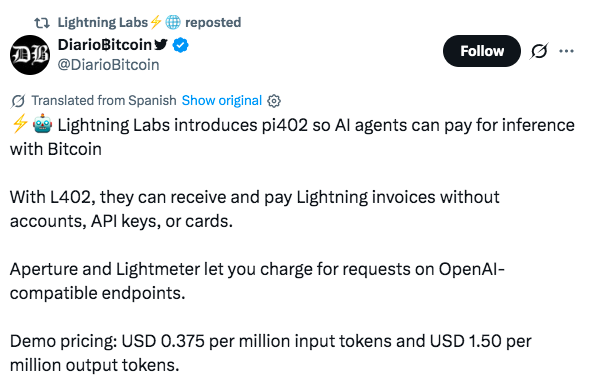
While Bitcoin’s Lightning Network has traditionally focused on faster and cheaper transactions, Lightning Labs has introduced a new technology called pi402 that allows AI coding agents to purchase computing services directly using BTC.
Announced on November 12, the open-source technology enables AI agents to pay for the computing power required to generate responses, analyze information, and perform other tasks.
The development could introduce a new source of Bitcoin payment activity as artificial intelligence becomes increasingly integrated into everyday digital services.
Lightning Labs Introduces Bitcoin Payments For AI Agents
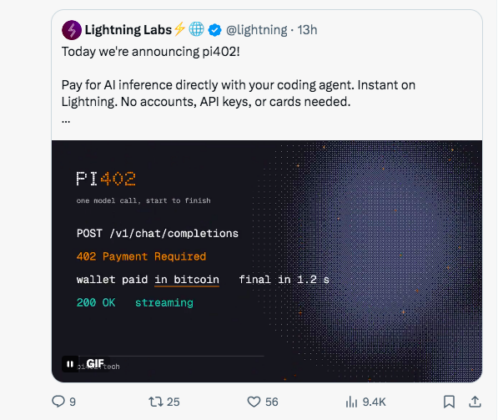
According to the official Lightning Labs announcement, pi402 allows AI coding agents to pay for inference directly through Bitcoin’s Lightning Network.
Inference refers to the computing process that occurs when an artificial intelligence model generates an answer or completes a task.
Traditionally, developers access these services through subscriptions, prepaid credits, or accounts linked to credit cards.
However, Lightning Labs believes this payment structure creates unnecessary obstacles for autonomous software.
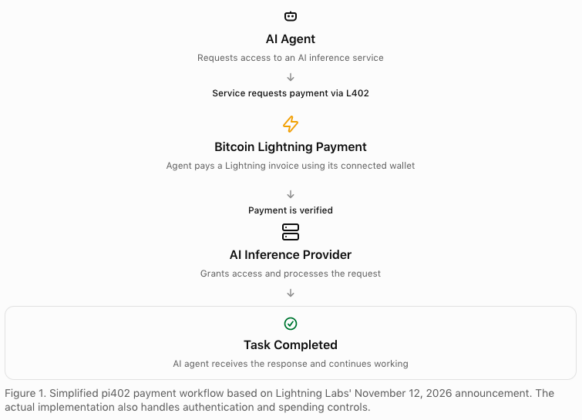
With pi402, an AI agent can request access to a paid service, receive a payment invoice, complete the transaction using Bitcoin, and continue its work without requiring a person to approve each purchase.
The system uses Lightning’s L402 payment authentication protocol, which combines payment verification with access to digital services.
Once the payment is completed, the agent receives the credentials needed to access the requested computing resources.
The process can happen within seconds, potentially allowing AI applications to make numerous small transactions without relying on traditional banking infrastructure.
Lightning Labs also introduced usage-based billing capabilities, enabling service providers to charge for individual AI tokens rather than requiring customers to purchase large packages in advance.
The technology builds on earlier efforts to expand Bitcoin payment applications beyond conventional cryptocurrency transfers.
Could Artificial Intelligence Create New Demand For Bitcoin?
The most interesting implication of pi402 is the possibility that autonomous AI agents could become a new category of Bitcoin users.
As artificial intelligence applications become more sophisticated, software agents may increasingly need to purchase data, computing power, and access to other digital services.
Rather than requiring a traditional bank account, these agents could use Bitcoin wallets to complete payments automatically.
This could make the Lightning Network particularly attractive for micropayments.
Unlike conventional card-based payment systems, where fixed processing fees can make very small transactions uneconomical, Lightning supports payments denominated in tiny fractions of Bitcoin.
Lightning Labs explained that its technology can meter AI inference in millisatoshis, with one millisatoshi representing one-thousandth of a satoshi.
This level of precision allows developers to charge for extremely small units of computing activity.
From an investment perspective, growing payment activity could strengthen Bitcoin’s role as an internet-native financial network.
However, increased Lightning transactions would not automatically translate into higher BTC prices.
The longer-term market effect would depend on adoption, the amount of Bitcoin held in payment wallets, and whether demand for BTC grows alongside the services being purchased.
Nevertheless, the development introduces another potential use case at a time when institutional interest in Bitcoin adoption continues expanding.
Why Bitcoin Could Benefit From The Growing AI Industry
Artificial intelligence and cryptocurrency have often been discussed as separate technology sectors.
However, autonomous payments could create an important connection between them.
AI agents are increasingly capable of completing complex tasks, but paying for services remains a challenge because traditional financial systems generally require human identities, account registration, and payment authorization.
Bitcoin’s Lightning Network offers a different approach.
By allowing software to hold limited balances and complete transactions programmatically, developers can create applications that pay for services as they are needed.
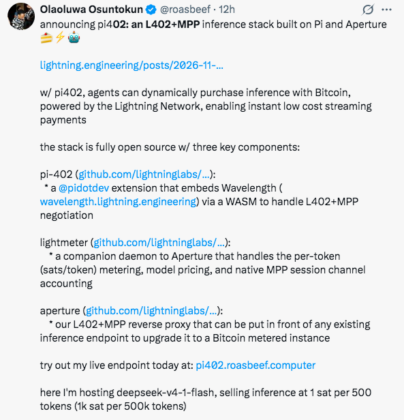
The pi402 extension also supports spending controls, including per-request limits and daily budgets, helping developers restrict how much an agent can spend.
Lightning Labs has made the technology open source, allowing developers to experiment with new payment applications.
There are still challenges.
Widespread adoption would require more AI service providers to accept Lightning payments, while developers would need to address wallet security, liquidity management, and the volatility associated with Bitcoin.
Even so, the announcement represents another step toward integrating Bitcoin into emerging digital infrastructure.
For now, pi402 is a new developer tool rather than evidence of widespread commercial adoption.
But if autonomous AI agents eventually become major consumers of computing services, Bitcoin could find an increasingly important role in how those machines exchange value.
And that could strengthen its long-term utility far beyond the cryptocurrency trading market.

You can get bonuses upto $100 FREE BONUS when you:
💰 Install these recommended apps:
💲 SocialGood - 100% Crypto Back on Everyday Shopping
💲 xPortal - The DeFi For The Next Billion
💲 CryptoTab Browser - Lightweight, fast, and ready to mine!
💰 Register on these recommended exchanges:
🟡 Binance🟡 Bitfinex🟡 Bitmart🟡 Bittrex🟡 Bitget
🟡 CoinEx🟡 Crypto.com🟡 Gate.io🟡 Huobi🟡 Kucoin.

















Comments